Quick answer: Is Canadian college cheaper than US college?
An American student pays international tuition at a Canadian university unless they hold Canadian citizenship or permanent resident status. For 2025/26, Statistics Canada puts the national undergraduate average at C$41,746 per year (~US$30,000), compared to C$7,734 (~US$5,570) for Canadian students (Statistics Canada, Sept. 2025).
Canada vs US tuition, side by side
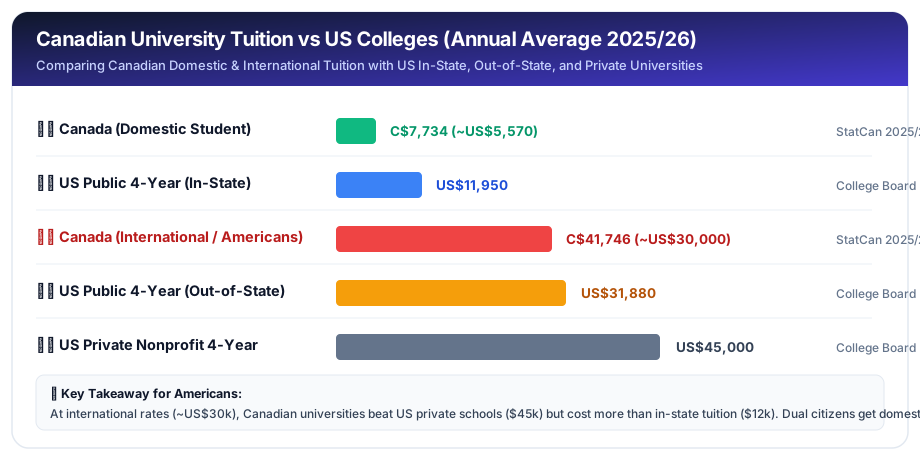
| Undergraduate, per year | Average tuition | Source |
|---|---|---|
| 🇨🇦 Canada — Canadian student | C$7,734 | StatCan 2025/26 |
| 🇺🇸 US public 4-year — in-state | US$11,950 | College Board 2025-26 |
| 🇺🇸 US public 4-year — out-of-state | US$31,880 | College Board 2025-26 |
| 🇨🇦 Canada — international (most Americans) | C$41,746 (~US$30,000) | StatCan 2025/26 |
| 🇺🇸 US private nonprofit 4-year | US$45,000 | College Board 2025-26 |
Published tuition and fees, before grants. Canadian figures are in Canadian dollars, which are worth less than US dollars — convert at the current rate (~US$0.72 per C$1.00). US figures: College Board, Trends in College Pricing 2025. US net prices after aid average about US$2,300 in-state and US$16,910 at private nonprofits.
Which province is cheapest for international students?
Tuition varies dramatically by province under provincial funding formulas. Statistics Canada's 2025/26 figures:
- Cheapest for international undergraduates: Newfoundland and Labrador, at C$18,867 a year — less than half the national average.
- Most expensive: Ontario, at C$49,802 a year for international undergraduates.
- Cheapest for Canadian students: Newfoundland and Labrador (C$3,746) and Quebec (C$3,963).
- Mid-range options: Alberta (C$33,100), Quebec (C$33,800), and British Columbia (C$38,400).
Tuition is only part of the cost. Rent in Toronto or Vancouver can outweigh a tuition difference — compare city living costs in the province calculator.
Total annual student budget by university city
Tuition is only one part of the student budget. Off-campus housing and provincial healthcare rules vary substantially across provinces (see our breakdown of international student health insurance by province). Below is an estimated 9-month academic year budget (September to April) for an international undergraduate across five major Canadian university centers:
| Metro / Universities | Undergrad Tuition (StatCan 2025/26) | Student Rent (9-Mo. Shared) | Health Insurance | Annual Total (CAD) | Est. in USD (~0.72) |
|---|---|---|---|---|---|
| Toronto & Waterloo, ON U of T, York, Waterloo |
C$49,802 | C$10,800 (~$1,200/mo) | C$756 (UHIP) | C$61,358 | ~US$44,180 |
| Vancouver, BC UBC, SFU |
C$38,400 | C$11,250 (~$1,250/mo) | C$675 (BC MSP $75/mo) | C$50,325 | ~US$36,230 |
| Montreal, QC McGill, Concordia |
C$33,800 | C$7,650 (~$850/mo) | C$1,080 (Univ. Plan) | C$42,530 | ~US$30,620 |
| Calgary & Edmonton, AB U of Calgary, U of Alberta |
C$33,100 | C$7,200 (~$800/mo) | C$0 (AHCIP eligible*) | C$40,300 | ~US$29,010 |
| St. John's, NL Memorial University |
C$18,867 | C$5,400 (~$600/mo) | C$0 (NL MCP eligible*) | C$24,267 | ~US$17,470 |
*Sources: Statistics Canada Table 37-10-0045-01 (provincial international undergraduate tuition averages); CMHC off-campus student accommodation estimates for shared rentals (September–April academic year); official provincial health plans (Alberta AHCIP and Newfoundland MCP cover international students holding a valid study permit of 12 months or longer at no monthly premium). USD conversions calculated at US$0.72 per C$1.00. Personal groceries, books, airfare, and discretionary spending are not included.
How Americans can qualify for Canadian (domestic) tuition
US federal aid and study permits
- Federal Direct Loans can be used at foreign schools that take part in US federal student aid, which includes many Canadian universities. Pell Grants cannot be used abroad. Look up the school on studentaid.gov.
- Study permit: required for programs longer than six months. US citizens and green-card holders can apply at the port of entry, but Canada now caps new study permits — check IRCC's study permit page.
- After graduation: an eligible program can lead to a post-graduation work permit, and Canadian work experience counts toward permanent residence through Express Entry.
Taxes for American & international students in Canada
Many international students assume they do not need to file Canadian taxes if their earnings are low or zero. In practice, filing a Canadian tax return (CRA Form T1) each spring provides valuable tax credits and direct government cash rebates:
| Tax Program | How It Works for Students | Financial Impact |
|---|---|---|
| Tuition Tax Credit (CRA Form T2202) |
Canadian universities issue Form T2202 each February reporting eligible tuition fees paid. This creates a federal non-refundable tax credit at the lowest federal rate (14% in 2026). When income during school is low, 100% of unused credits carry forward indefinitely. After graduation, these accumulated credits can offset thousands of dollars of income tax on full-time Canadian earnings (e.g., on a PGWP), or up to C$5,000 can be transferred annually to a parent or spouse. | Accumulates thousands of dollars in future income tax deductions. |
| GST/HST Credit & Provincial Rebates | The Canada Revenue Agency issues quarterly tax-free payments to lower-income residents aged 19 and older. Filing a Canadian tax return automatically triggers these rebates even with C$0 earned income. In Ontario, students renting off-campus also qualify for the Ontario Trillium Benefit energy and property tax credit. | Up to C$679/year federal Canada Groceries and Essentials Benefit (July 2026–June 2027, single person; replaces the GST/HST credit) plus provincial rental and sales tax credits. |
| Part-Time Work & Basic Personal Amount | Students authorized to work off-campus (up to 24 hours per week during academic terms under updated IRCC rules) benefit from Canada's federal Basic Personal Amount (C$16,452 in 2026). Earnings up to this threshold incur zero federal income tax, and income tax withheld by the employer is refunded upon filing. CPP and EI contributions are not refunded. | Refund of federal income tax withheld on earnings under C$16,452 (CPP/EI still apply). |
| US Citizen Dual Filing & FBAR | US citizens must continue filing an annual US return (IRS Form 1040) on worldwide income. Most students owe zero US tax by utilizing the standard deduction or Foreign Tax Credit. Reporting requirement: If total balances across all Canadian bank accounts reach US$10,000 or more at any point in the calendar year, you must submit an annual FBAR (FinCEN 114) by April 15 (automatic extension to October 15). See our Canada vs US tax guide for cross-border filing details. | Mandatory annual IRS and Treasury reporting; zero double taxation. |
Frequently asked questions
Add rent and living costs by province
Tuition is one line. See rent, groceries and take-home pay for the city you'd study in.